
Cornerstone guide
Moss on Your Roof: The Complete Pacific Northwest Owner's Manual
The short answer
Moss holds water against your shingles year-round and pries them upward as it grows — it's structural damage on a timer, not a cosmetic issue. Soft-wash treatment kills it, zinc or copper strips suppress regrowth for 2–3 years, and pressure washing destroys the granules that are your roof. Treat every 2–3 years under PNW canopy.
 Illustration
Moss is the Pacific Northwest’s signature roof problem — our mild, wet climate is nearly perfect for it, and most homeowners treat it as a cosmetic issue until the repair bill explains otherwise. Here’s the whole picture.
What moss actually does to a roof
Three things, all bad:
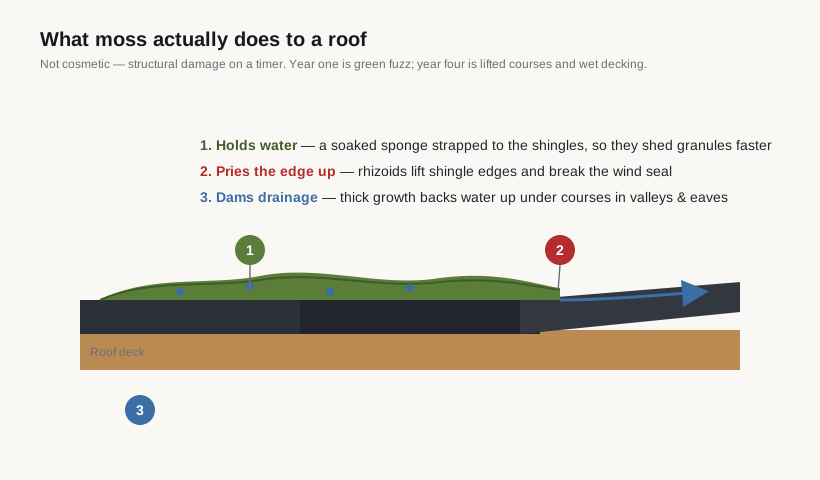
- It holds water. A moss mat works like a soaked sponge strapped to your shingles, keeping the surface wet for days after rain stops. Perpetually wet asphalt sheds granules faster and feeds rot in any exposed wood.
- It pries. Moss rhizoids work under shingle edges and physically lift them as the colony thickens. Lifted edges break wind seals and open capillary paths for water to travel uphill — the leak shows up two rooms from the moss.
- It dams. Thick growth in valleys and along eaves interrupts drainage, backing water up under courses that were never designed to be submerged.
The compounding is the trap: year one is green fuzz, year four is lifted courses and wet decking. The gap between a $600 treatment and a $6,000 repair is mostly just waiting.
Why you must never pressure-wash asphalt shingles
The ceramic granules on a shingle are the shingle — they’re the UV armor protecting the asphalt and fiberglass underneath. A pressure washer strips them by the pound, along with the moss. The roof looks brilliantly clean and has quietly lost years of life. Any company that offers to pressure-wash your composition roof is charging you to shorten it. (Metal roofs tolerate washing; asphalt never does.)
What actually works
Soft-wash treatment. Moss-killing solutions applied at garden-sprayer pressure kill the colony at the root. Dead moss releases its grip and sheds off gradually with weather — heavy mats get gentle manual removal after they die back, never scraping against live, gripping growth.
Zinc or copper strips. Installed at ridges, they release trace metal ions with every rain, suppressing regrowth down-slope for years. This is the closest thing to set-and-forget moss control that exists.
Trimming and light. Moss needs shade and moisture. Selective limbing that gets even partial sun onto a north slope measurably slows regrowth.
Gutter discipline. Clogged gutters keep roof edges wet — which is exactly where moss starts. Clean gutters (or micro-mesh guards if you’re done with the ladder) are moss prevention.
The PNW maintenance calendar
- Every fall: clear debris and gutters; visual moss check from the ground.
- Every 2–3 years: soft-wash treatment (more often under heavy fir canopy — Lake Stevens lakefront, Veneta oak cover, and similar shade zones run on the 2-year end).
- Once: zinc/copper ridge strips at the next cleaning or reroof.
- Cedar owners: this entire calendar is mandatory, not optional — moss management is half the cost of owning shake, and we put that schedule in writing before any cedar work.
When cleaning is the wrong answer
| Your roof’s condition | The honest move |
|---|---|
| Sound shingles, surface moss | Soft-wash treatment + zinc/copper ridge strips |
| Lifted edges, minor damage, life left | Targeted repair + treatment, then maintain |
| Bald, brittle, past ~25 years | Replace — cleaning is cosmetics on borrowed time |
If the shingles underneath are done — bald, brittle, past 25 years — cleaning is cosmetics on borrowed time. We’ve told plenty of homeowners exactly that, and we’ve also restored roofs other companies quoted for full replacement: one Friendly-neighborhood bungalow in Eugene was bid $19,000 for a new roof and needed about $3,000 of honest care. The difference is an inspection that photographs what’s actually there.
Green roof? Get the free assessment — we’ll tell you in photos whether it needs treatment, repair, or genuinely nothing yet.
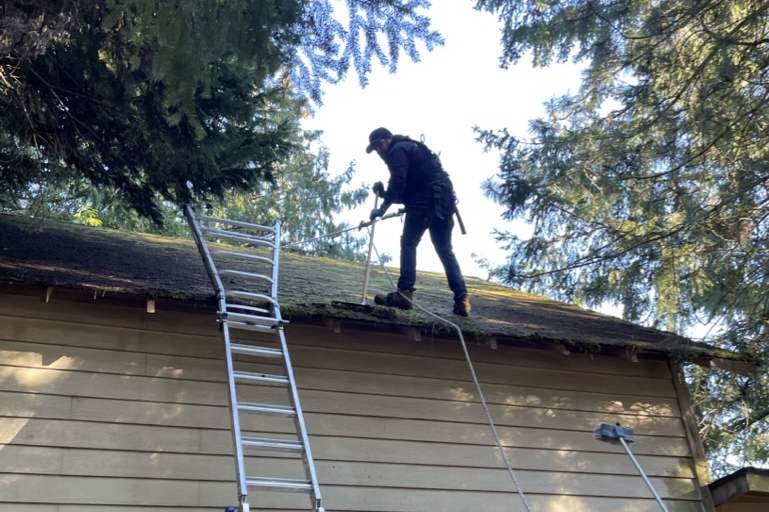 See it on a real jobMoss-Choked Roof Restored, Not ReplacedBothell, WA · A Bothell home shaded by mature firs had moss thick enough to hold moisture year-round. Another bid called for full replacement. The shingles underneath had life left.
Sources & methodology
- Asphalt Roofing Manufacturers Association (ARMA) — algae & moss on roofs
- Washington State University Extension — moss control in the landscape & on structures
Insurance, permit and code details vary by policy and jurisdiction. This guide is general information from our field experience, not individualized professional advice.