
Cornerstone guide
The Pacific Northwest Storm Damage Playbook: What to Do in the First 48 Hours
The short answer
After storm damage: get people safe, photograph everything from the ground, call for emergency tarping before calling your insurer, don't sign anything on your porch, and get damage documented within days — most policies have claim deadlines and evidence fades fast.
Windstorms off the Sound, ice storms over Spokane, tree strikes in the Willamette Valley — Northwest storms damage thousands of roofs a year, and the 48 hours afterward decide whether it becomes a smooth insurance claim or an expensive mess. Here’s the playbook.
The first 48 hours, at a glance
| Do | Don’t |
|---|---|
| Get people clear of sagging ceilings or downed wires — call 911 if needed | Get on the roof — storm-loosened shingles send homeowners to the ER |
| Photograph everything from the ground before anything is moved | Sign an AOB or “contingency agreement” on your porch |
| Call a local contractor for emergency tarping, and keep receipts | Let anyone “eat your deductible” — that’s fraud with your name on it |
| Get an independent inspection before you file | File a claim before you know it’s peril, not wear |
Hour zero: safety, then nothing else
If a tree is on the structure, if wires are down, or if the ceiling is sagging with water weight — get out and call 911 before any contractor. A bulging ceiling can hold gallons; don’t poke it, and stay out of that room.
Hours 0–2: stop the bleeding
Water coming in? Buckets and towels first, then move valuables out from under the leak path. If it’s safe, puncture-drain a water-bulged ceiling at the edge of the bulge into a bucket — a controlled drip beats a collapse.
Do not get on your roof. Storm-loosened shingles and wet moss put homeowners in emergency rooms every winter. Ground-level phone photos are all you need right now.
Hours 2–24: document, then stabilize
Photograph everything before anything is moved or repaired. Shingles in the yard (with something for scale), visible roof damage from the ground, interior stains, the fallen limb, standing water. Time-stamped phone photos are ideal claim evidence.
Call for emergency tarping. A reputable local contractor (that’s us: 360-404-7835, 24/7) will stabilize the roof and document damage professionally while doing it. Emergency mitigation is almost always covered by your policy — keep every receipt. Insurers actually require you to prevent further damage; waiting can reduce your payout.
The porch test: spotting the storm-chaser
After every major PNW storm, out-of-state trucks appear. Some are honest. The predatory ones share a script — refuse anyone who:
- Offers to “eat your deductible.” That’s insurance fraud with your signature on it.
- Wants you to sign an assignment of benefits or “contingency agreement” today, before an inspection report exists. You’re signing away control of your own claim.
- Pressures you to file a claim before any inspection. Claims are recorded whether paid or not; a frivolous one can affect your rates.
- Has no local address you can drive to. When the warranty question comes in year three, that truck is three states away.
The tell is always urgency. Real damage is documentable, real contractors put license numbers on everything (ours: WA L&I lookup), and a real claim survives a 48-hour think.
Days 1–5: the claim, in the right order
- Get an independent inspection first — free from us, with an adjuster-formatted photo report. Now you know if the damage justifies a claim at all: a $900 repair against a $2,500 deductible doesn’t.
- File with photos and your report attached. Note your policy’s claim deadline — carriers commonly require prompt notice, and some WA/OR policies now have one-year suit limitations.
- Have your contractor at the adjuster meeting. The adjuster walks your roof once. Someone should be up there speaking scope, code upgrades, and matching-material rules on your behalf. We attend at no charge for our clients.
- Understand ACV vs. RCV before accepting numbers — replacement-cost policies pay withheld depreciation only after work completes, which trips up homeowners who pocket the first check and delay.
What wind damage actually looks like
From the ground: shingle tabs in the yard, black exposure lines where tabs lifted, creased or flipped-back shingles, dented or detached gutters and flashing, granule piles at downspout outlets. Half of the wind damage we document was invisible to the homeowner who called “just to be safe.”
Roof emergency right now? Skip the reading: call our 24/7 line or book an inspection if it can wait until daylight. Either way — don’t sign anything on your porch this week.
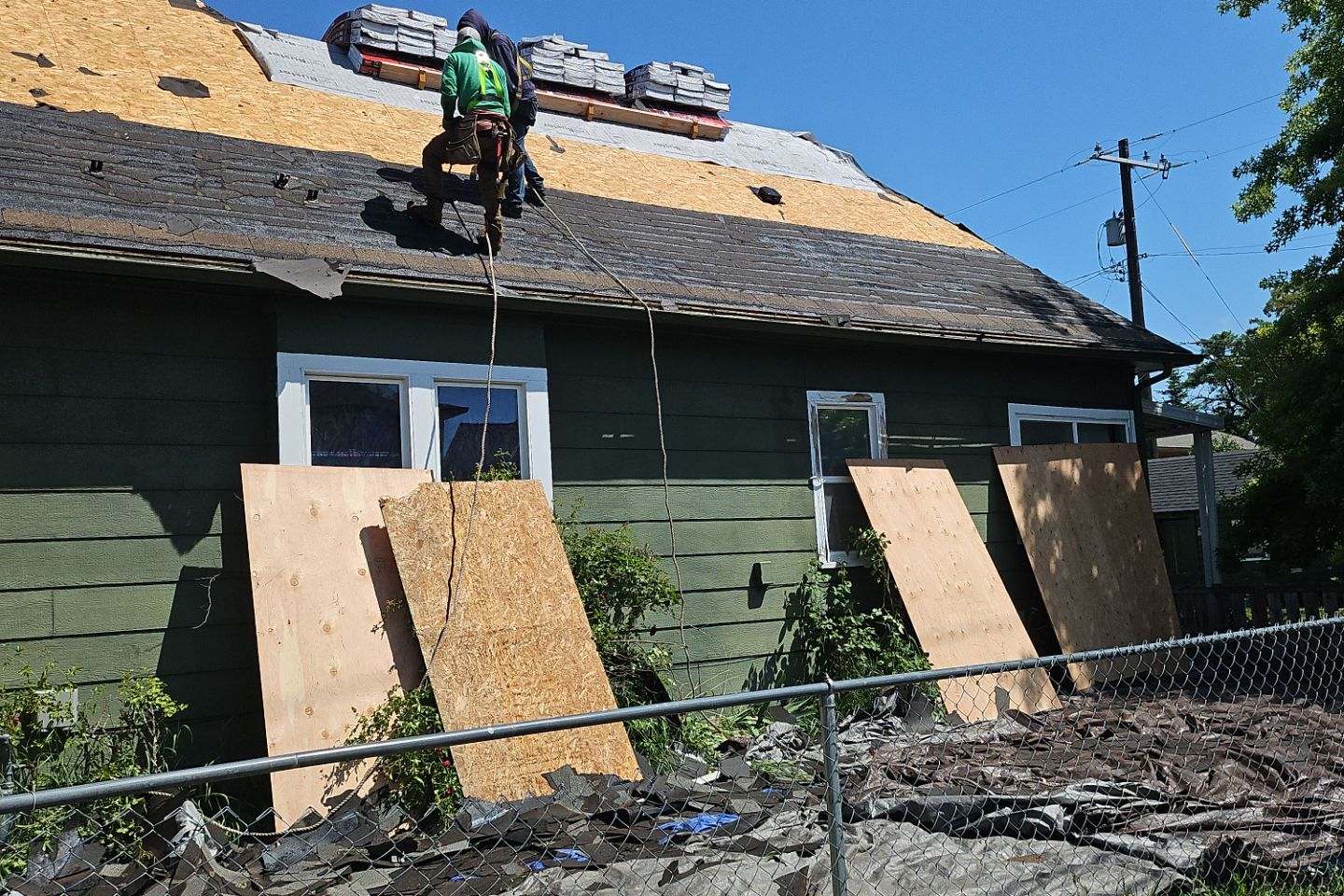 See it on a real jobStorm-Stripped Roof Rebuilt, Insurance Claim HandledSpokane, WA · A windstorm tore into this Spokane home hard enough to take the roof down to the decking. The homeowner's first call was to their insurance carrier — their second was to us.
Sources & methodology
- Washington State Office of the Insurance Commissioner — filing a home-insurance claim
- Oregon Division of Financial Regulation — homeowner insurance & claims
- Peaks & Valleys — WA contractor license verifiable via L&I
Insurance, permit and code details vary by policy and jurisdiction. This guide is general information from our field experience, not individualized professional advice.