
Cornerstone guide
The PNW Roof Maintenance Calendar: What to Do, When, and What It Buys You
The short answer
PNW roofs need a fall clean-out (gutters, debris, visual check) before the November storms, a spring inspection after winter's damage is done, moss treatment every 2–3 years, and a professional inspection every 2 years or after any major storm. Total cost: a few hundred dollars a year. Payoff: roughly 5 extra years on a $20,000 asset.
A 20-year roof and a 25-year roof are usually the same roof — one was maintained. Here is the entire calendar, honestly costed, for Washington and Oregon homes. Nothing on this list requires you on a ladder; most of it is a walk around the yard and two phone calls a year.
October — the one that matters most
The November storm season is the PNW roofing year’s main event, and October is your last calm month before it. Before the first big front:
- Gutters and downspouts cleared — full gutters overflow at the eave, soak the fascia, and start ice dams east of the mountains. If you’re on the ladder twice a year and tired of it, micro-mesh guards retire the chore for good.
- Debris off the roof — needle mats in valleys hold water against the exact seams that keep it out.
- Ground-level visual check — curled tabs, dark exposure lines, anything crooked. Ten minutes with your phone camera; the photos become your before/after baseline if a storm hits.
- Trees trimmed to clearance — limbs that touch the roof abrade it every windy night, and they’re the moss superhighway.
November–February — storm season protocol
Nothing scheduled — this is response season. After any storm with real wind: walk the yard, look for shingle pieces and granule piles, photograph anything suspicious within days (wind-lifted shingles reseal in warm spells and hide the evidence). Spokane-side homes: watch for icicles — they’re the attic warning light, not a decoration.
March–April — the damage audit
Winter’s bill arrives in spring. One walk-around: flashing lines straight? Ridge caps intact? Gutter seams weeping? Interior check of ceilings and attic (musty smell = ventilation problem). Every second spring — or every spring for roofs past 15 — make this a professional inspection. Ours are free, photographed, and plenty conclude “you’re fine,” which is the point of an audit.
May–June — moss treatment window
Late spring is the sweet spot for soft-wash moss treatment: growth is active (treatments work best on growing moss) and summer weather sheds the dead material. Every 2–3 years for most homes, every 2 under heavy canopy. Never pressure washing — here’s why that ruins roofs.
July–September — the project window
Dry season is when planned work happens on your schedule instead of a leak’s: replacements, ventilation corrections, skylight reseals, and the repairs spring’s audit found. Contractors’ calendars fill by June — homeowners who inspected in April pick their week; homeowners who waited for October’s first leak join a queue in the rain.
The math, plainly
| Habit | Cost | What it buys |
|---|---|---|
| Fall clean-out (DIY or ~$150–$350 hired) | ~$300/yr | Prevents eave rot, ice dams, overflow damage |
| Moss treatment every 2–3 yrs | ~$450–$1,200 | Stops the #1 PNW shingle killer |
| Professional inspection every 2 yrs | Free (ours) | Catches $600 problems before they’re $6,000 |
| Post-storm photo walk | Free | Preserves insurance evidence before it fades |
Call it a few hundred dollars a year against a $12,000–$28,000 asset — and the difference between replacing at year 20 and year 25 is worth roughly $4,000–$7,000 in deferred cost alone. Maintenance isn’t a chore the roof demands; it’s the highest-yield investment the roof offers.
Want the calendar running without thinking about it? Book the free inspection and ask for the maintenance schedule — we’ll put your roof’s specific version in writing.
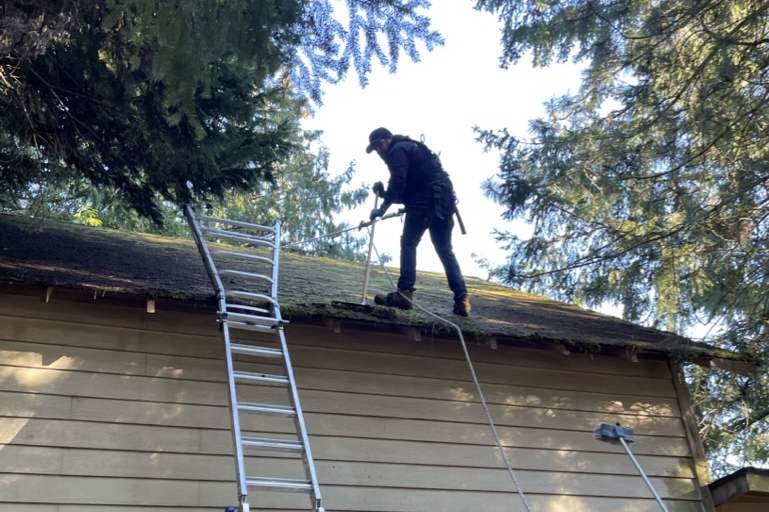 See it on a real jobMoss-Choked Roof Restored, Not ReplacedBothell, WA · A Bothell home shaded by mature firs had moss thick enough to hold moisture year-round. Another bid called for full replacement. The shingles underneath had life left.
Sources & methodology
- Asphalt Roofing Manufacturers Association (ARMA) — homeowner roof maintenance
- Owens Corning — shingle roof care & maintenance guidance
Insurance, permit and code details vary by policy and jurisdiction. This guide is general information from our field experience, not individualized professional advice.