
Materials & Systems
Snow Guards & Snow Retention on Metal Roofs
The short answer
Metal roofs shed snow in sudden slides that can injure people and damage decks, gutters, and gas meters below. Snow retention — rail/fence systems or individual guards — holds the snowpack so it melts off gradually. It must be engineered to each roof plane's pitch and snow load and placed above doors, walkways, and equipment. It's not optional in snow country.
Part of our guide to The Best Roofing Materials for the Pacific Northwest (Ranked by Situation).
A standing-seam metal roof is one of the best choices you can make in snow country — it sheds snow instead of stacking it, which spares your structure the load. But “sheds snow” has a catch: without snow retention, it can shed the whole plane’s worth of snow at once, onto whatever — or whoever — is below. Here’s how to get the benefit without the hazard.
Why uncontrolled shedding is a real problem
The same slick surface that keeps snow from piling up also lets a warmed snowpack release in a sudden slab. That mass, sliding off a second-story plane, can:
- Injure someone standing at a door or on a walkway
- Crush a deck, patio cover, or landscaping
- Tear off gutters and downspouts
- Bury or damage a gas meter, heat pump, or AC unit
- Block an entry or driveway
None of that is hypothetical in the Inland Northwest. It’s exactly why a cheap metal install that skips retention isn’t a bargain — it’s a liability.
How snow retention works
Snow retention holds the snowpack on the roof so it melts and releases gradually and predictably, instead of avalanching. Two main approaches:
| System | How it works | Best for |
|---|---|---|
| Rail / fence systems | Continuous bars span the plane, holding the whole snowpack | Real snow loads; the preferred choice in snow country |
| Individual guards | Pad-style pieces distributed across the field | Lighter loads, supplemental use |
The rail approach is stronger and is what we specify for serious snow. Whatever the type, on a standing-seam roof the components usually clamp to the seams without penetrating the panel, so they don’t compromise the roof — and they can often be added to an existing metal roof.
Why it has to be engineered, not sprinkled on
This is the part cheap installs get wrong. Snow retention isn’t decoration you scatter across the roof — it’s a load-bearing system. The layout and quantity have to be calculated for:
- The snow load your area actually sees
- The pitch and length of each roof plane
- The panel type and how the guards attach
- What’s below each plane that needs protecting
Placed correctly, retention holds the snow where the structure can carry it and releases it away from doors, walkways, and equipment. Placed randomly, a guard can fail under load — which is worse than having none. We engineer it per plane on every snow-country metal install, and we’ll retrofit it on an existing roof the same way.
The bottom line
If you’re putting metal on a home that sees real winter — Spokane, the foothills, North Idaho — snow retention isn’t an upgrade, it’s part of doing the roof correctly. Ask any metal bid how they’re handling snow retention and how it’s engineered. A blank look is your answer.
Getting a metal roof in snow country, or worried about your existing one shedding onto a doorway? Book a free inspection — we’ll assess the planes, the load, and what needs protecting, and lay out retention that’s engineered, not guessed. See the metal roofing service.
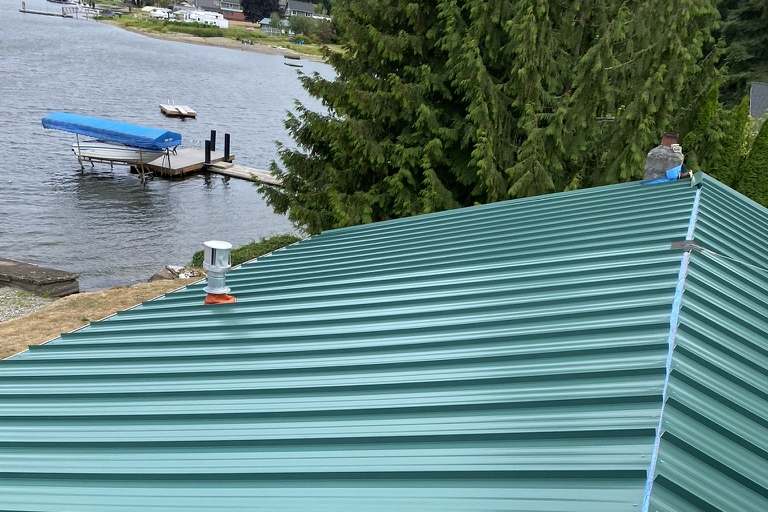 See it on a real jobIce Dam Problem Solved with Standing-Seam MetalSpokane, WA · A lake home in the Spokane area grew three-foot icicles every January and had ceiling staining in two rooms. Two previous contractors had quoted shingle replacements — treating the symptom, not the attic heat loss driving it.